Conventional
HFO, LFO, MDO, MGO
FuelEU Maritime caps the GHG intensity (greenhouse-gas emissions per megajoule of energy used) of fuels burned on voyages touching EU/EEA ports. The target tightens every five years, pushing the fleet toward low- and zero-carbon fuels.
The metric is Well-to-Wake (WtW): it counts emissions from extracting and producing the fuel (Well-to-Tank) plus emissions from burning it on board (Tank-to-Wake), expressed in gCO₂eq per MJ.
Ships 5,000 GT and above on voyages calling EU/EEA ports — Regulation (EU) 2023/1805. In force from 1 January 2025.
Baseline: 91.16 gCO₂eq/MJ (2020 fleet average).
| Year | Target intensity (gCO₂eq/MJ) | Reduction vs. baseline |
|---|---|---|
| 2025 | 89.34 | −2% |
| 2030 | 85.69 | −6% |
| 2035 | 77.94 | −14.5% |
| 2040 | 62.90 | −31% |
| 2045 | 34.64 | −62% |
| 2050 | 18.23 | −80% |
Targets are step-wise — the 2025 figure applies through 2029, then drops at 2030, and so on.
The platform handles 19 fuel types with EU Annex II default emission factors built in:
Conventional
HFO, LFO, MDO, MGO
Alternative fossil
LNG, fossil Methanol, LPG (Propane / Butane), Ammonia (Grey), Hydrogen (Grey)
Biofuels
FAME, HVO, Bio-Methanol, Bio-LNG, Bio-Blend (with bunker-cert dating)
E-fuels & green
E-Methanol, E-LNG, Ammonia (Green), Hydrogen (Green)
For LNG, the platform applies methane slip based on engine type:
Biofuel blends are dated — pre-8-Aug-2025 bunkers use a certified WtW of 9.2 gCO₂eq/MJ; post-cutoff bunkers use 10.8 gCO₂eq/MJ. The platform tracks consumption date so the right factor is applied.
Compliance is computed at the fleet level (per operator):
Fleet GHG Intensity = Σ (Energy × WtW) / Σ EnergyCompliance Balance = (Target − Actual) × Total EnergyA negative balance means a deficit. The penalty is:
Penalty (€) = |Balance| / Actual Intensity × (€2,400 / 41,000 MJ)That formula expresses the penalty as the EUR cost of the energy gap valued at VLSFO equivalent — €2,400 per tonne of VLSFO (≈ 41,000 MJ).
You can also avoid penalty through:
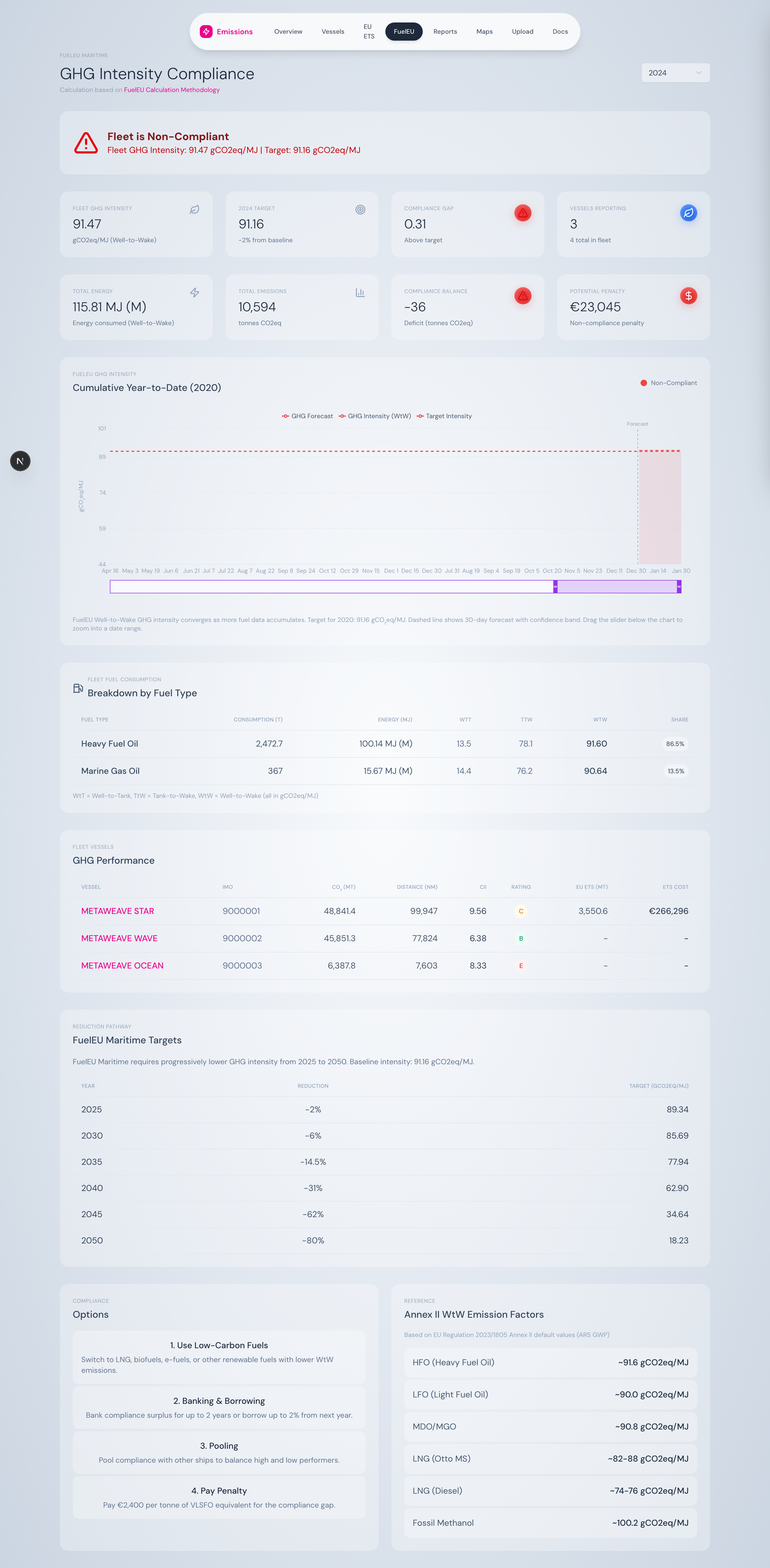
FuelEU dashboard — compliance status, daily intensity vs. target, and fuel mix.
A FuelEU Maritime Report with fleet GHG intensity, fuel mix, compliance balance, and penalty projection — formatted for verifier submission. See Reports hub.